
-
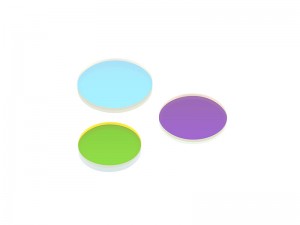
The narrow band filter optical lenses
The so-called narrow-band filter is subdivided from the band-pass filter, and its definition is the same as that of the band-pass filter, that is, the filter allows the optical signal to pass through in a specific wavelength band, and deviates from the band-pass filter. The optical signals on both sides are blocked, and the passband of the narrowband filter is relatively narrow, generally less than 5% of the central wavelength value.
The main function of the narrow-band filter is to pass light of a specific wavelength and reflect (or attenuate) optical components of light of other wavelengths. The half-wave width is usually controlled at 20nm or less, and can be used in ultraviolet, visible light, near-infrared wavelengths, and far-infrared bands. Our company’s narrow-band filters are formed by high-vacuum evaporation of multi-layer hard films and ion-assisted deposition of nanomaterials. Good compactness and high imaging definition.
-
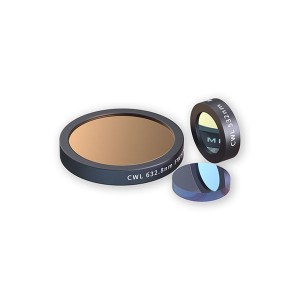
High Performance Narrow Band Bandpass Filter
High transmittance (Tmax> 90%),
Deep cut-off depth (ODmax> 6), etc., which are widely used in microscopic imaging, spectroscopy, biochemical analysis instruments.
-
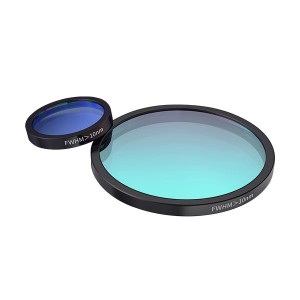
Domestic Bandpass Filters
Bandpass Filters are ideal for many applications, such as spectroscopy, clinical chemistry, or imaging.
Grand Unified Optics provides a variety of half-bandwidth bandpass interference filter with a variety of
transmission and sizes to suit your application.
-
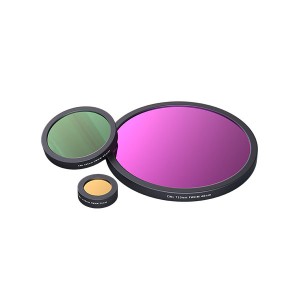
Fluorescence Bandpass Filter
The filter has high transmittance and deep cut-off. It is widely used in fluorescence microscopy imaging,
fluorescence optical instruments, life sciences, education and scientific research and other related fields
-
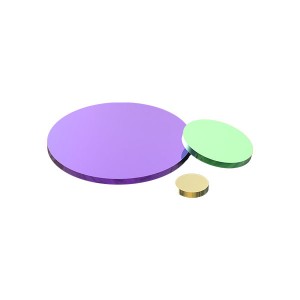
High Performance Shortpass Filter
Shortpass filters provided by Precision stages feature wide blocking bandwidth,
High blocking depth,high transmission and high blocking slope.
-
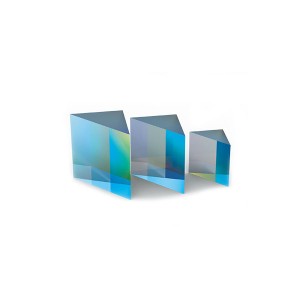
UV Fused Silica Standard Precision Right Angle Prisms
Right angle prisms are typically used to bend the image path or turn the light path by 90°.
Combining two right angle prisms can also combine the image and deflect the beam.
